Amended versions of 2 crypto mining bills clear Arkansas Senate committee
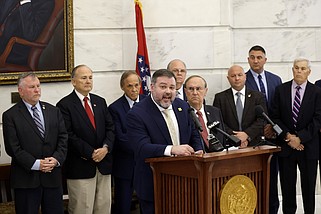
Amended versions of two bills meant to impose greater restrictions on crypto mining in Arkansas cleared the Senate's City, County and Local Affairs Committee on Thursday.

Amended versions of two bills meant to impose greater restrictions on crypto mining in Arkansas cleared the Senate's City, County and Local Affairs Committee on Thursday.

Restauranteur and area civic leader Capi Peck joins Rex on this week’s episode to discuss, most notably, the litter, trash and graffiti problems that plague th…
HOT SPRINGS -- A Bonnerdale woman who kept two juveniles left in her care locked in their rooms last year, prompting one to escape through a window to seek foo…
HOT SPRINGS -- Two Hot Springs police officers who were placed on administrative leave after a Sherwood parolee was killed in an exchange of gunfire with the o…
North Carolina-Charlotte transfer linebacker Nikhai Hill-Green’s interest in Arkansas and the Hogs’ interest in him lured him to Fayetteville for an official v…
Early jitters cost the University of Arkansas gymnastics team, which failed to advance out of their semifinal at the NCAA Championships on Thursday afternoon.
FAYETTEVILLE -- Peyton Holt is back in the starting lineup for the No. 2-ranked University of Arkansas baseball team's series at No. 21 South Carolina this wee…
Are you a rose? A lily? A Venus fly trap? Take our fun quiz to find out!
Tyler Perry has signed a new, nonexclusive deal with BET to ensure fresh seasons of eight existing shows as well as a new series. This replaces his existing de…
Dardanelle, circa 1910: The jauntily dressed group parked in a 1910 Buick on the dirt street were sipping sodas, apparently served by the young man balancing…
P.A.M Transport Services Inc. on Thursday reported a 17.6% drop in revenue in the first quarter of 2024.
Share price released
Giant apple snails were recently reported in crawfish shipments from Louisiana delivered to two south Arkansas restaurants. If established in Arkansas, the inv…
Several months ago, I began a series of columns exposing the University of Arkansas at Fayetteville's King Fahd Middle Eastern Studies Center's myopic focus on…
You'd be forgiven if you tend to cringe when thinking about 18-wheelers running down the highway without drivers.
After Iran's massive retaliation for the Israeli strike against Iran's diplomatic compound in Damascus, it now falls to President Joe Biden to prevent subseque…
WASHINGTON -- House congressional leaders were toiling Thursday on a delicate, bipartisan push toward weekend votes to approve a $95 billion package of foreign…
NEW YORK -- A jury of 12 people was seated Thursday in former President Donald Trump's history-making hush money trial, propelling the proceedings closer to op…
Israel launched a retaliatory strike on Iran less than a week after Tehran's rocket and drone barrage, according to two U.S. officials.